Catch the risky change in the pull request, not in production.
Runtimez checks every change against what is actually running, then records each rollout and the diff behind it. When something breaks, you can see what changed right before it.
one helm install · get, list, watch only · first findings in minutes
Overview
Most incidents start with a change. Runtimez reviews the change before it merges — against the live cluster, not just against main — and afterwards keeps a field-level record of every rollout, so “what changed?” always has an answer.
A verdict on the pull request, against live state
60+ manifest rules plus live-diff rules that compare the PR with what is actually running.
- Flags a probe removed, a PDB weakened, replicas cut, limits reduced, anti-affinity dropped, ingress TLS removed, a service exposed or a PVC shrunk.
- GitOps-aware: fields managed by Flux or Argo CD are not reported as drift on every reconcile.
- Config blast radius: knows whether a changed ConfigMap feeds one workload or forty.
minAvailable: 2 can no longer be met; node drains will stall.Field-level before and after, for every change
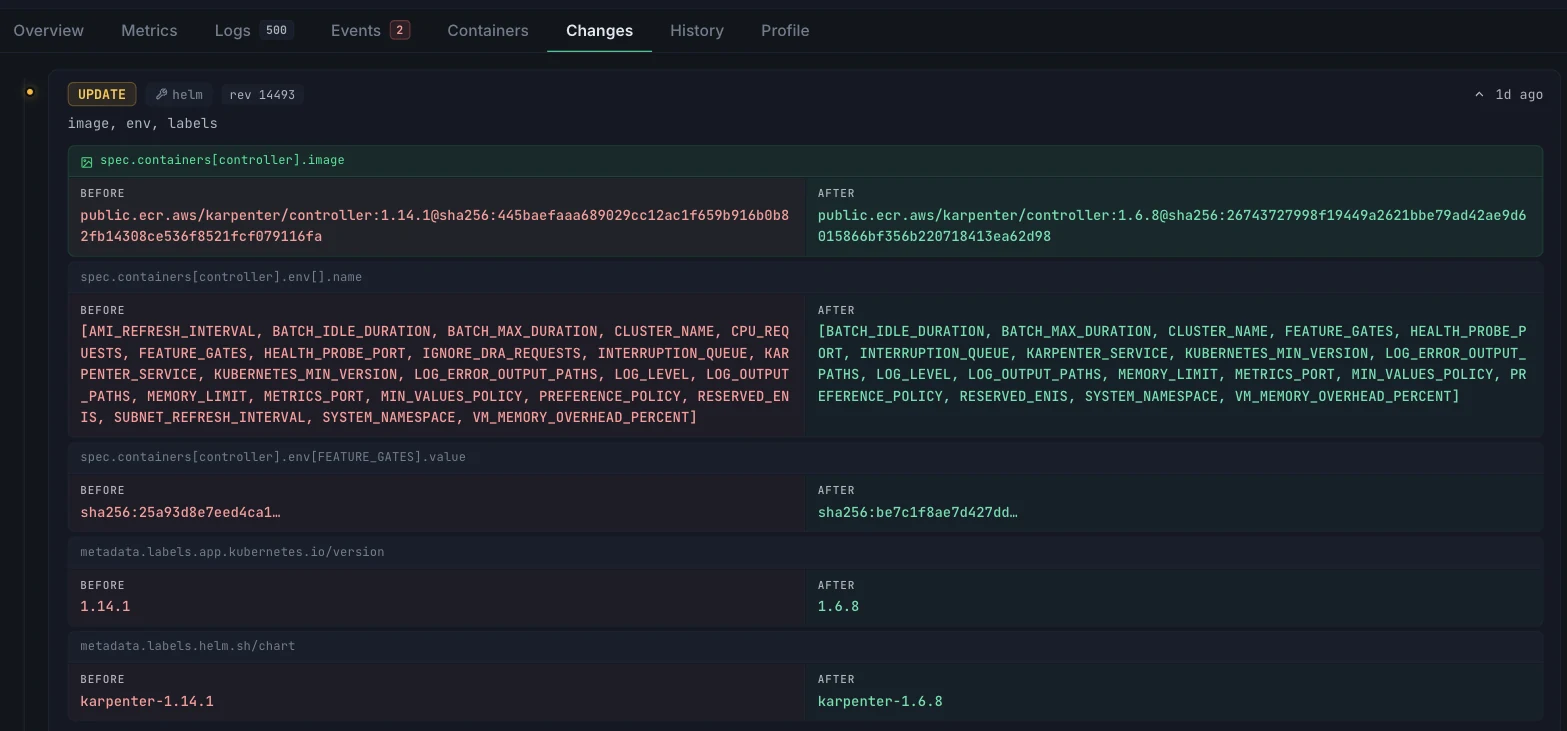
Each change is recorded with the fields that moved and who moved them — Helm, an admission webhook or the platform.
- Image, env, labels and chart version, side by side.
- Changes attributed to their source, so a webhook injection is not mistaken for a deploy.
- Diff any two points in time for a workload.
Who changed what, right before it broke
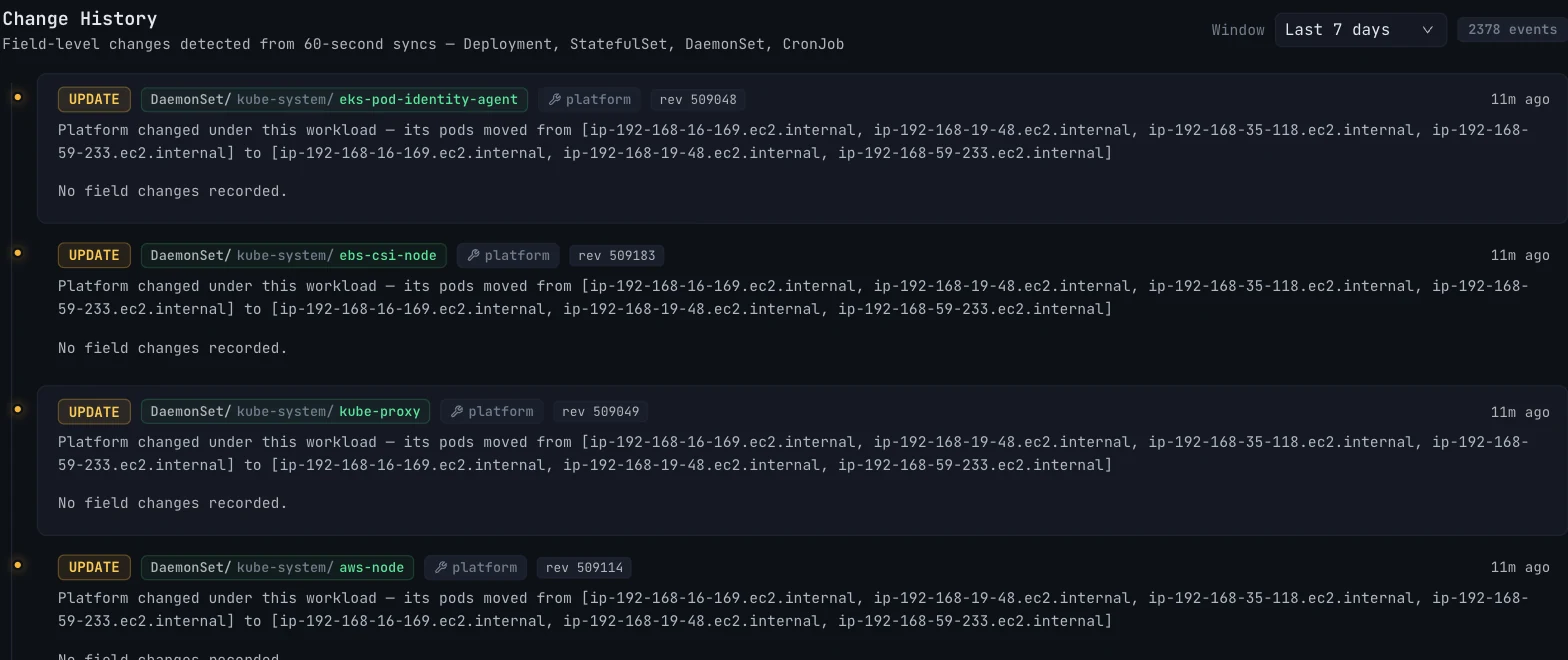
An append-only change history for every Deployment, StatefulSet, DaemonSet and CronJob, from 60-second syncs.
- Platform changes under a workload — nodes joining, pods moving, Karpenter disruption taints — shown next to deploys.
- Pick the time window you need and filter by workload kind.
- Cluster diff sessions compare two spans for a canary or release, with evidence bundles.
More in Safe Deployments
Everything else that ships in this product today.
Change-failure rate
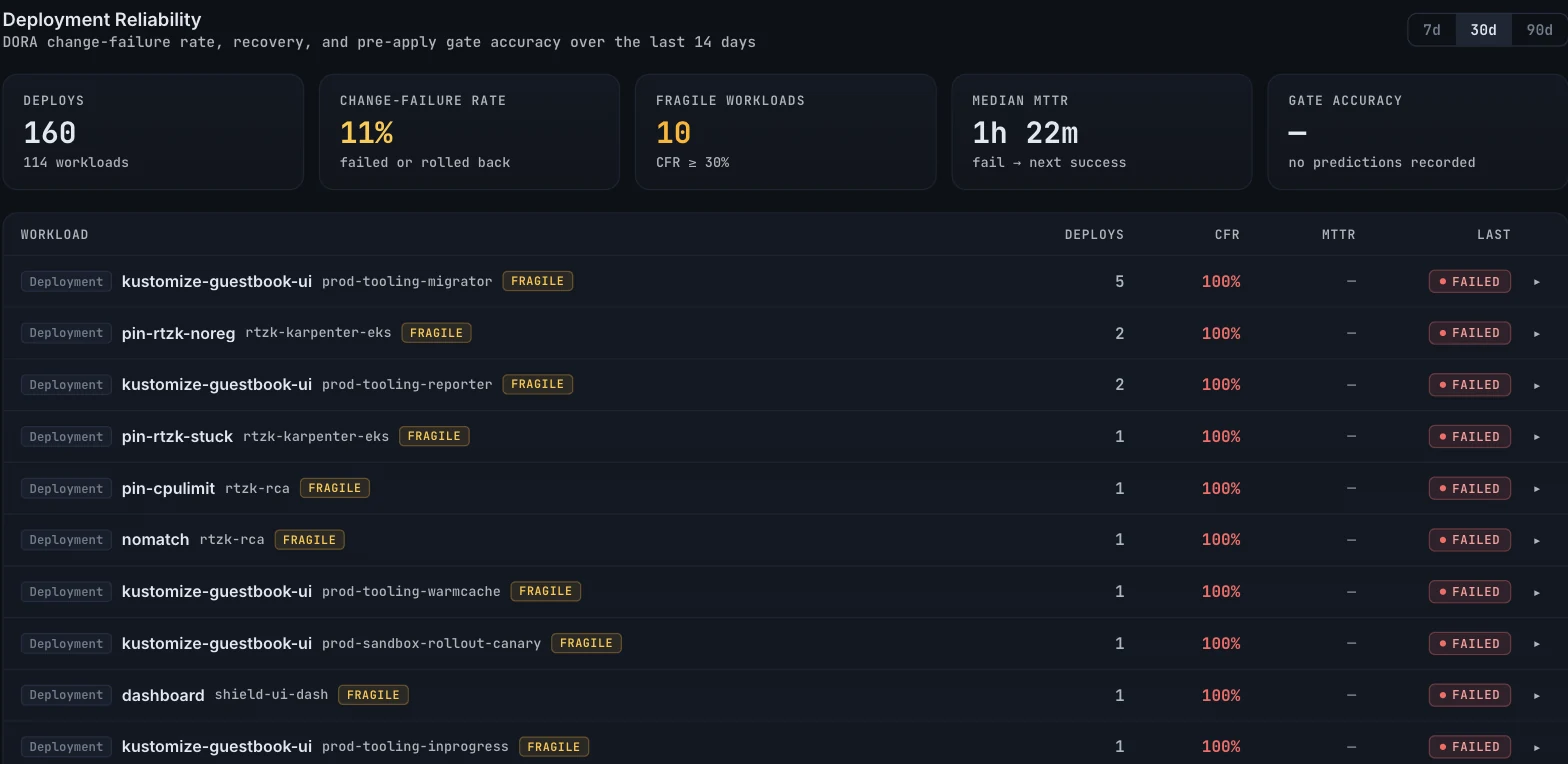
Every rollout classified as success, failure or rollback, rolled up into deploys, change-failure rate and median time to recover.
Fragile workloads
Workloads whose deploys fail at least 30% of the time, ranked, with the failure reason for each rollout.
Upgrade rules at PR time
The Upgrade Readiness rules run against the rendered bundle, so a removed API never reaches the cluster.
Predictions that grade themselves
Records each predicted outcome and publishes its own accuracy, including the false-positive rate.
Version change summary
What changed between two cluster versions.
Rollout verdicts in Slack
Degraded releases reach the channel you already use.
How it compares
They enforce the rules you wrote. Runtimez ships the 200+ rules you did not know to write, and checks changes against what is actually running.
Does the PR check need access to production?
It compares against the live state the read-only agent already collects, so no cluster credentials are handed to your CI.
Does it block merges?
It posts a verdict with the reasons. How your pipeline treats a blocking finding is up to you.
Will GitOps reconciles show up as drift?
No. Fields managed by Flux or Argo CD are recognized, so a normal reconcile is not reported as drift.
What counts as a failed deploy?
A rollout that failed or was rolled back. Change-failure rate is computed over those outcomes, and time to recover runs from the failure to the next success.
Related reading
One agent, the rest of the platform
Every product runs off the same read-only sweep and feeds the same ranked queue.
See it on your own cluster in under an hour.
Free for your first cluster. Read-only by default. Uninstall is one helm command.