
An AI SRE that shows its evidence — and says when it doesn't know.
Ask your cluster a question and get an answer built from its own events, logs, traces and add-on state. Every claim cites its evidence, and when the evidence is not there, it says so.
one helm install · get, list, watch only · first findings in minutes
Overview
Runtimez gathers evidence deterministically first — events, logs, restarts, probes, rollouts, HPA, metrics, traces, add-on findings and mesh traffic — and only then makes one bounded model call to write it up. Answers are scoped to your cluster and read-only, and off-topic questions are refused instead of made up.
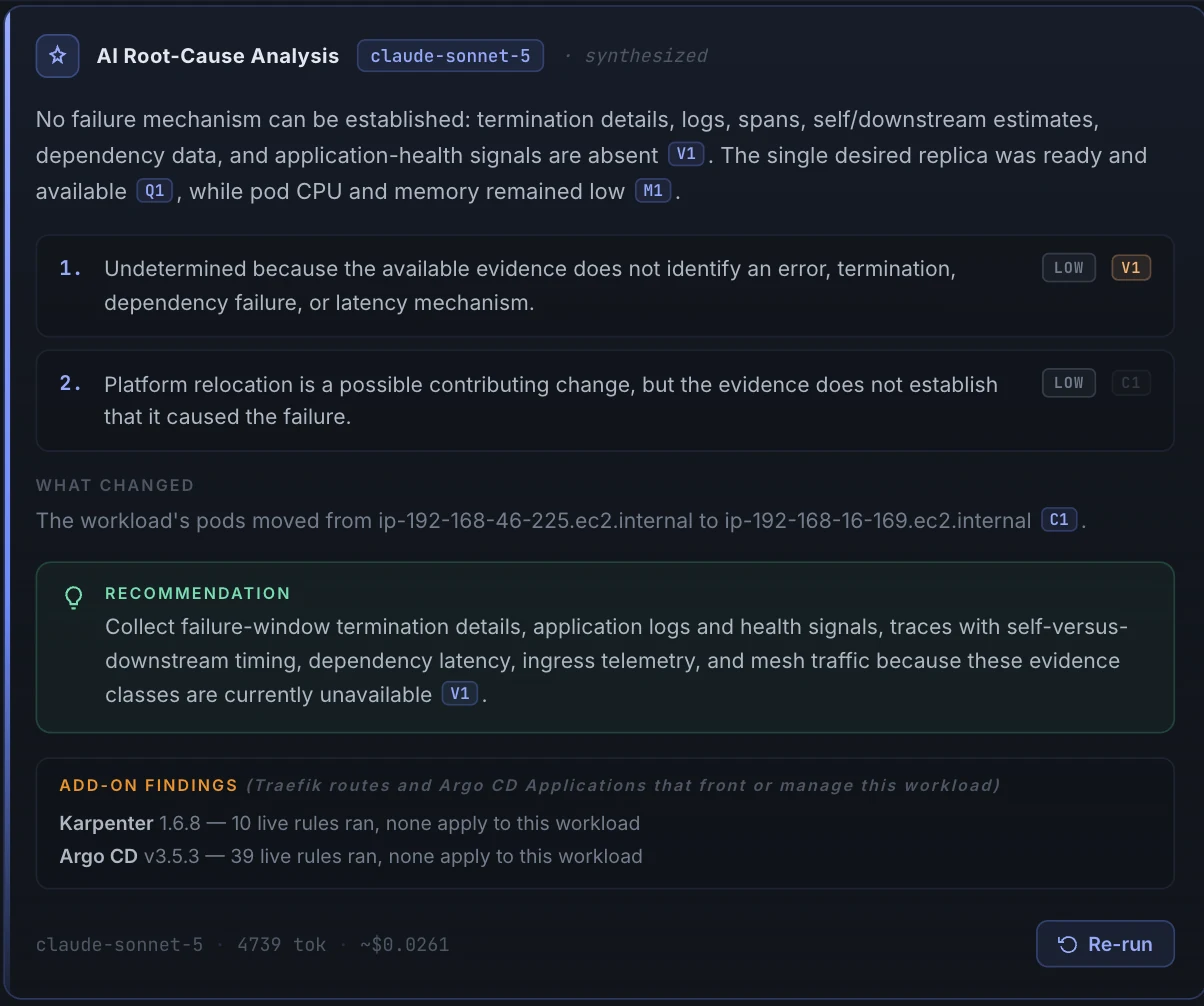
Every sentence cites its evidence
One click on any workload runs an RCA. Hypotheses are ranked, and each is tagged with the evidence it rests on.
- Evidence references like
V1,Q1andC1link each claim to the signal behind it. - When the evidence cannot establish a cause, the answer says so and lists what to collect — no confabulated root cause.
- Add-on rules that ran for the workload are listed, even when none applied.
Start from the symptom, not the dashboard
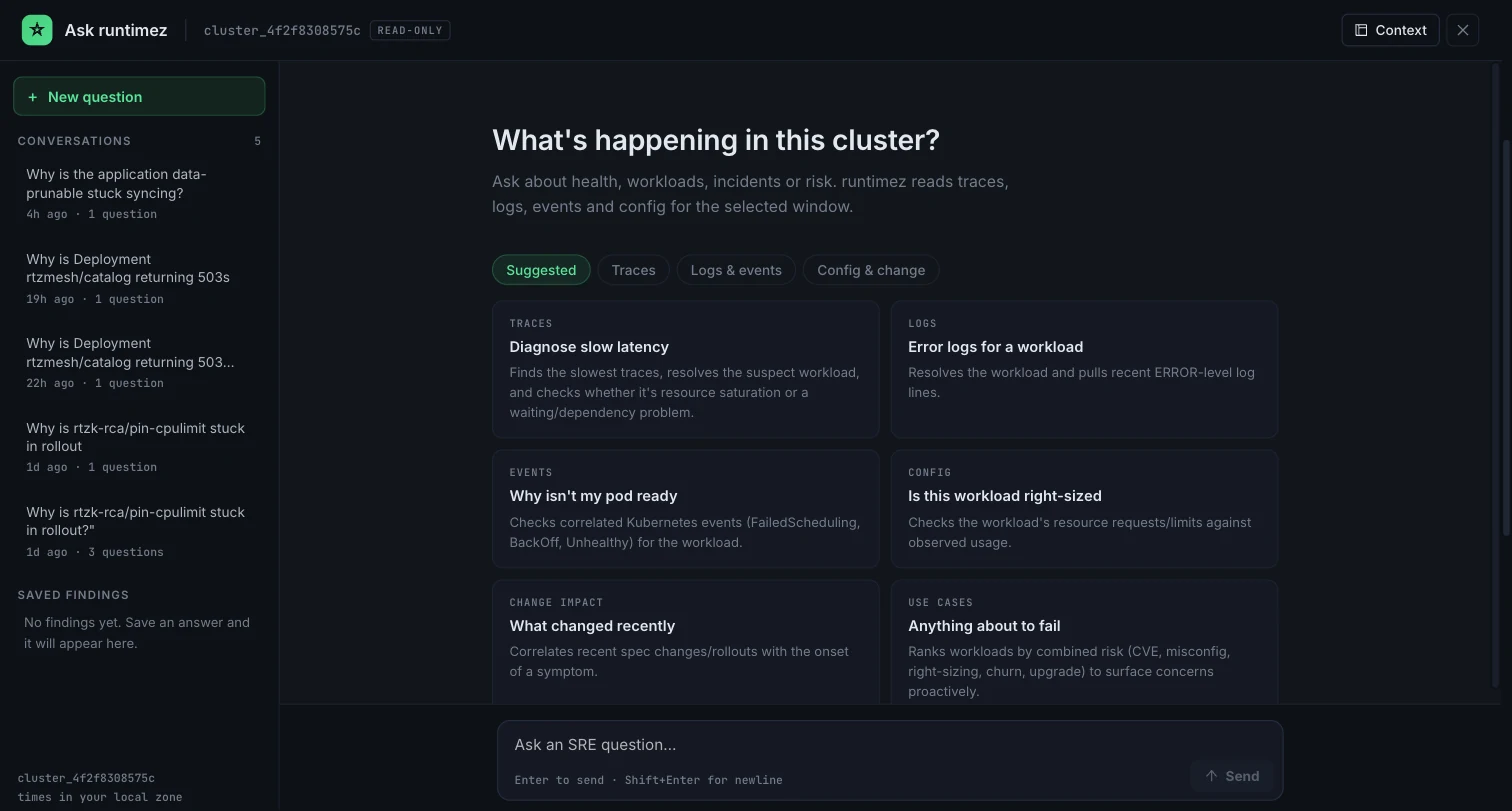
Ask in plain English, or pick a starting point: slow latency, error logs, a pod that is not ready, what changed, or what is about to fail.
- Answers read traces, logs, events and config for the selected window.
- Every answer shows the tools it called and the data it read, and can be saved as a finding.
- Conversations are kept per cluster and deep-link from Slack.
Answers in the add-on's own words
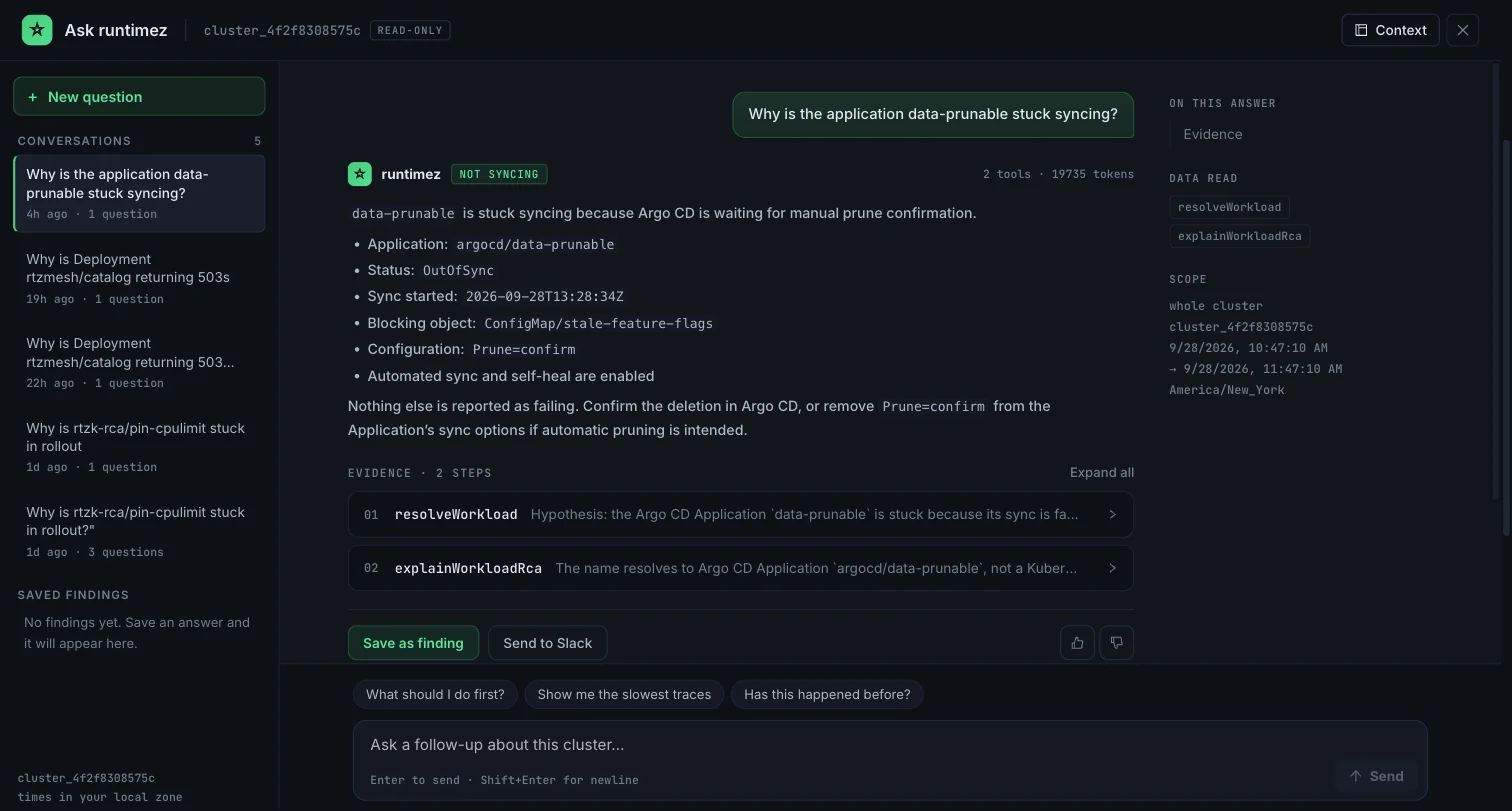
Argo CD sync states, Karpenter NodePool verdicts, Traefik routers and Envoy response flags are part of the evidence.
- “Why is no node coming?” names the Karpenter NodePool that refused the pod, and why.
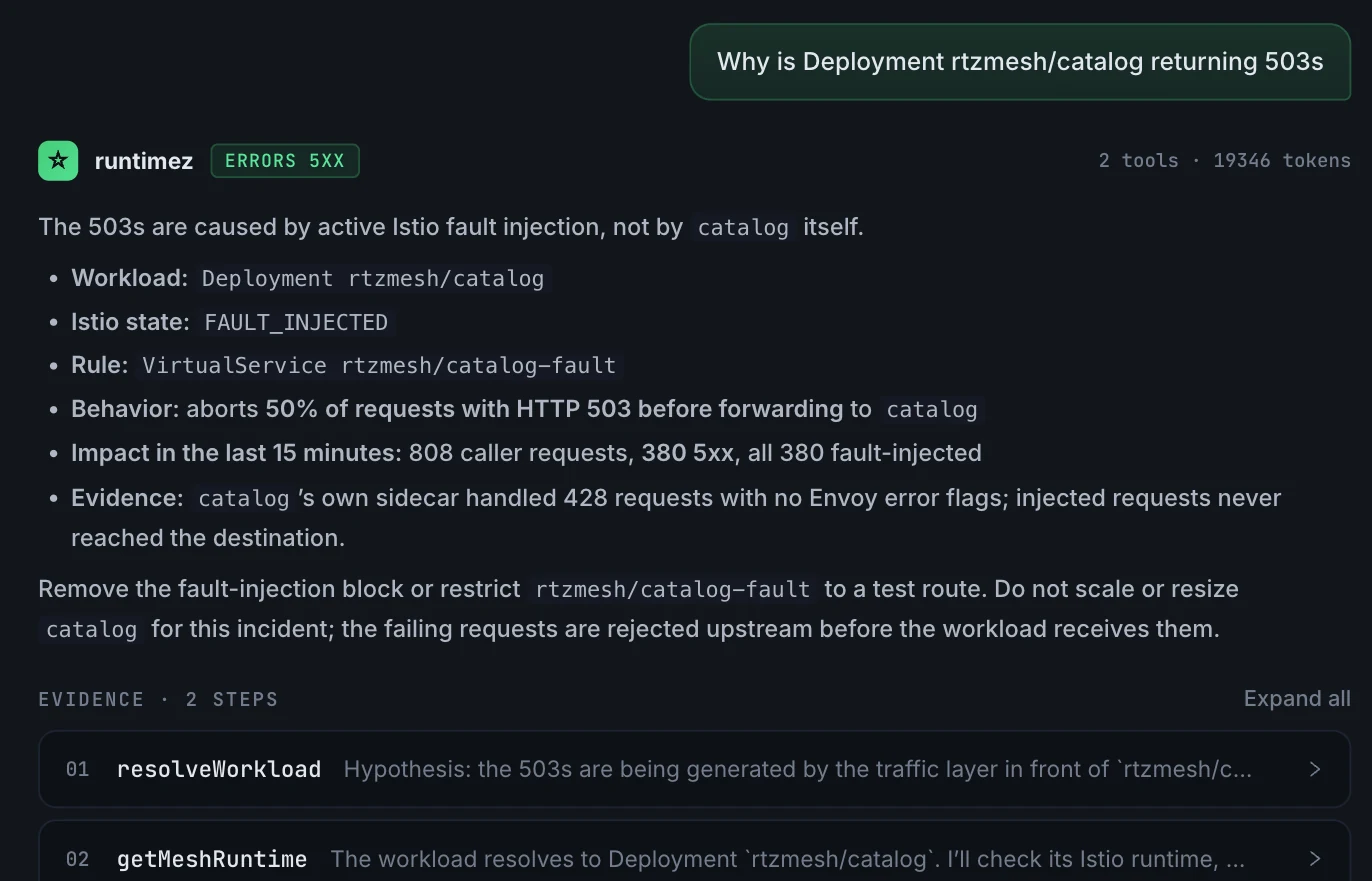
- 503s traced to an Istio fault injection, with request counts — and a warning not to scale the workload.
- Failure signatures are cached, so a repeat incident is answered instantly.
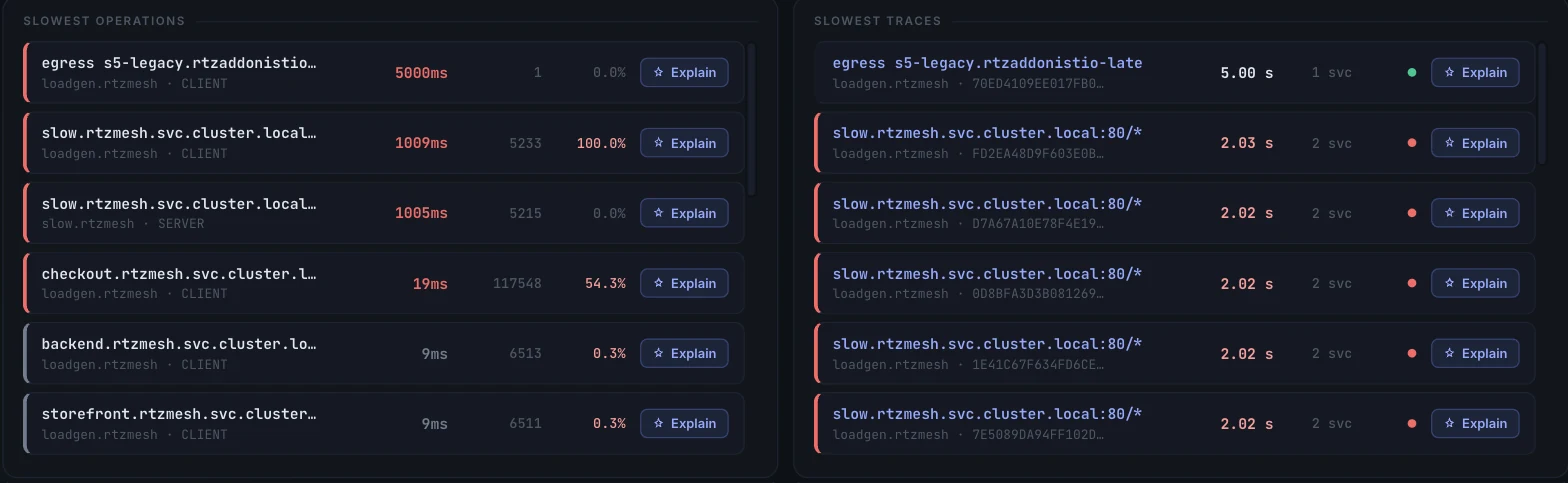
The slow span, explained
Slowest operations and traces, each one click from an explanation.
- Per-trace critical path, self-time and per-edge latency.
- CPU and allocation profiles captured during a debug session, without an always-on profiler.
- Secret redaction on every AI path: evidence is scrubbed before it reaches a model.
Your fleet, as a tool your AI assistant can call
57 read-only MCP tools for Claude, Cursor or any MCP client, and the same data in your terminal with rtz.
- Inventory, changes, risk, the readiness ledger, observability and RCA — all read-only, rate-limited and audited.
- Every answer carries its syncId and resolves workloads before acting, so the assistant never guesses a namespace.
- Per-org add-on packs for GitOps, mesh, certificates, ingress and autoscaling.
> what blocks test-cluster from upgrading to 1.35?

● runtimez_readiness_summary  cluster="test-cluster" target="1.35"
  └ NOT READY · 2 blocking · 17 findings · syncId 8f3c2a…

● runtimez_readiness_rule  ruleId="rtz-addon-karpenter-k8s-unsupported"
  └ Karpenter 1.6.8 does not support Kubernetes 1.35
    vendor matrix: 1.6 supports 1.26–1.34 · upgrade to 1.9+ first

Two things block 1.35: upgrade Karpenter to 1.9+, then check
each node's cgroup version (kubelet sets failCgroupV1=false).
Everything else is review-only.
More in AI SRE
Everything else that ships in this product today.
Auto-RCA with causal chain
Root cause, then propagation, then symptom, hop by hop.
Named failure causes
A liveness probe killing a container that never finished booting, scaled to zero, image pull failure, missing config reference, a PDB blocking a drain.
Slack
Ask Runtimez answers and alerts in the channel you already use, with a link back to the conversation.
AI insights feed
A ranked list of what needs attention: security, reliability, cost, hygiene, anomalies, top movers and forecasts.
Scope guardrail
Off-topic questions are refused instead of answered badly.
rtz CLI with TUI
Fleet, cluster, workload, pod and events from the terminal, plus an rtz mcp bridge.
How it compares
They tell you what broke. Runtimez tells you what will break, and why it broke, with citations.
Which model does Runtimez use?
RCA gathers evidence deterministically, then makes one bounded call to a large language model to write it up. The model and token cost are shown on every analysis.
Can the AI change anything in my cluster?
No. Every tool is read-only — the agent only has get, list and watch, and the MCP server exposes read-only tools.
Is my data sent to the model?
Only the evidence for the question, with secrets redacted first. Secret values are never collected in the first place.
How do I connect Claude or Cursor?
Point your MCP client at the Runtimez MCP server — the docs have the setup — or use the rtz mcp bridge from the CLI.
Related reading
One agent, the rest of the platform
Every product runs off the same read-only sweep and feeds the same ranked queue.
See it on your own cluster in under an hour.
Free for your first cluster. Read-only by default. Uninstall is one helm command.